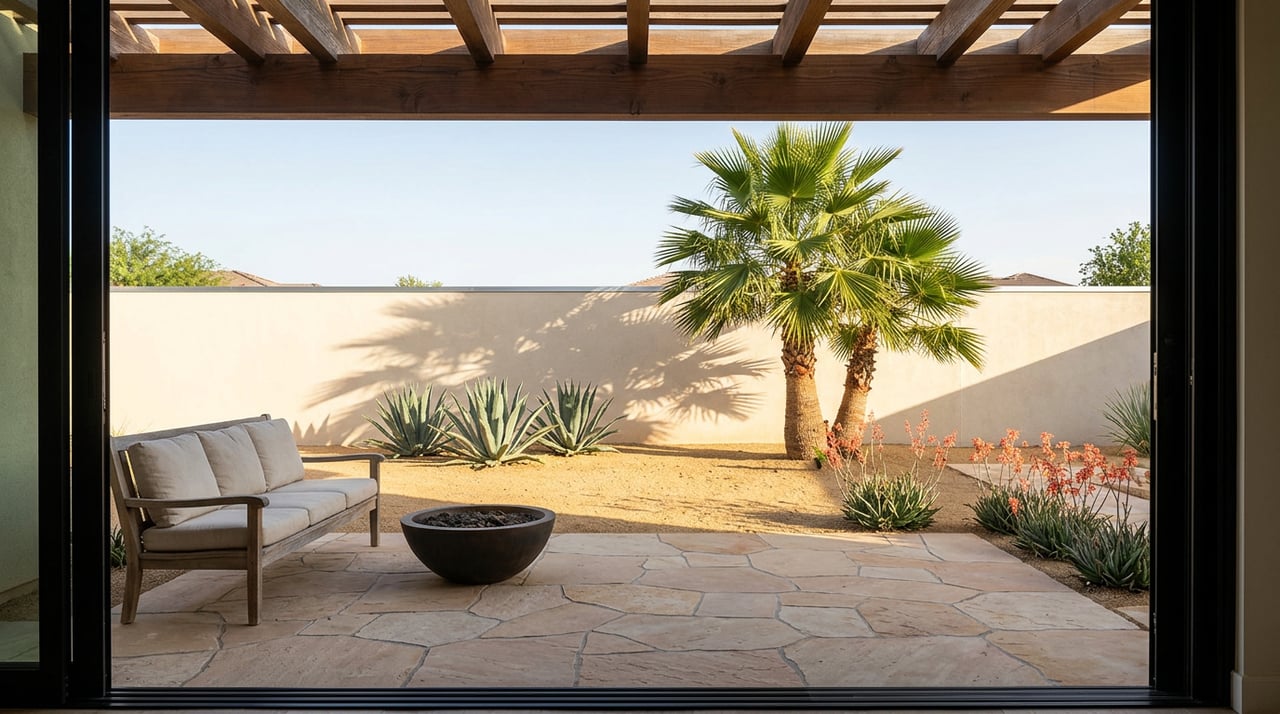
Man O' War Road Is a Trailhead, Not a Dead End
September 24, 2026
September 24, 2026
Ask most people in Bloomington what's at the end of Man O' War Road and they'll tell you: a park, some pickleball courts, and then the road just stops. That's true as far as it goes. It's also the wrong way to think about the place.
Bloomington Park, at 650 Man O' War Road, isn't the end of anything. It's the southern anchor of the paved Virgin River Trail system, the same corridor that threads north through St. George. Stand at that trailhead and you're standing at the literal starting point of a route that, if you follow it far enough, passes a rock panel carved before Columbus reached the continent, a set of tennis courts most Bloomington residents have never noticed, and a hilltop view that people currently drive across town to find. Almost nobody walks the whole thing. Most residents use one piece of it and assume that's all there is.
Bloomington Park does the job most people ask of it. It has seven public pickleball courts, ball fields, and enough open grass for a Saturday morning full of dogs and strollers. Compare that to Little Valley, the city's marquee pickleball complex a few miles north with 33 courts and a stadium-style championship court added in 2024. Little Valley draws the tournament crowd and the snowbird rotation from October through April. Bloomington's seven courts draw the opposite: shorter waits, no paddle-up lines stacking three deep, and a setting one local court guide describes as quieter by design.
The city leaned into that quieter identity rather than fighting it. Bloomington's courts got shade structures added in 2025, part of the same capital bond that funded playground replacements and trail work across St. George's park system. It's a small addition, but it's the kind of detail that tells you which parks the city expects people to keep using in July, not just April.
What most people miss is that this same park is also mile zero. The paved path that starts at the parking lot doesn't just loop the ball fields. It's the confirmed southern endpoint of the Virgin River North Trail, the corridor that eventually threads past soccer fields, crosses River Road, and reaches Crosby Family Confluence Park, the spot where the Santa Clara and Virgin Rivers actually meet.
Before you even get to the river corridor, there's a stop most Bloomington residents drive past without knowing it exists. From the Man O' War Road turnoff, follow Bloomington Drive about 1.3 miles as it winds through the neighborhood, then turn onto Navajo Drive. A tenth of a mile later, you're standing in front of Bloomington Petroglyph Park, a half-acre site where a cluster of boulders carries rock art believed to date back as far as 300 to 1300 A.D.
The park exists because of a specific, small story. Nellie and Harold Chesler were hiking with their grandchildren, Shellee and Logan, when the kids scrambled up a boulder and found the carvings. Harold, a retired Salt Lake County Justice of the Peace who later served as president of the Bloomington Country Club, helped push the idea of preserving the site into an actual plan, and the city credits him with helping create not just the petroglyph park but the surrounding walking trails and Bloomington Park itself. The carvings he helped protect now sit in the middle of an ordinary subdivision street, the kind of contrast that makes first-time visitors do a double take.
A few things are worth knowing before you go:
Here's what the network actually looks like once you stop treating each piece as its own separate errand.
| Stop | Distance or effort | What's there |
|---|---|---|
| Bloomington Park, 650 Man O' War Rd | Trailhead | 7 pickleball courts, ball fields, start of the paved river corridor |
| Bloomington Petroglyph Park | 1.4 miles via Bloomington Dr and Navajo Dr | A boulder panel of rock art estimated at 700 to 1,700 years old |
| Larkspur Park and Bloomington Hills North Park ("Long Park") | Further up the corridor, across Fort Pierce Drive | Three tennis courts, a roughly 10-acre grass loop, heavy dog-walker and jogger traffic |
| Webb Hill Trail | A one-mile climb gaining about 400 feet | A hilltop view of the valley that most residents currently drive elsewhere to get |
| Crosby Family Confluence Park | Northern link point | Where the Santa Clara and Virgin Rivers meet, and where the trail system connects toward Santa Clara and Washington |
None of these stops require a car. They require knowing the corridor connects them, which most people don't, because most people only ever use the segment closest to their own driveway.
The Bloomington Hills side of the corridor works differently from the flat, straight paths near Man O' War Road. Cross Fort Pierce Drive and you hit Bloomington Hills North Park, nicknamed Long Park by residents because it's a half-mile-long strip of grass rather than a square. It's hilly enough to notice, narrow in spots, and popular with runners because the walking trail splits into two loops instead of one straight line. From there the corridor connects to Larkspur Park's three tennis courts and its own short looped trail before feeding into the base of Webb Hill.
Webb Hill itself is a genuine climb by neighborhood-park standards, about 400 feet of gain over a single mile on Hillside Avenue. It's steep enough that most casual dog walkers turn back at Long Park instead of pushing on, which means the view at the top stays uncrowded even on weekend mornings. That's the part of the thesis worth sitting with: the same paved system that starts at a quiet neighborhood park in Bloomington ends, a few connected segments later, at one of the better unofficial viewpoints in this part of St. George, and the only reason it isn't busier is that the connection isn't obvious from either end.
Bloomington Country Club anchors the middle of all this, an 18-hole, par-72 course designed by William F. Bell that stretches to 6,818 yards from the championship tees and hosted the Utah State Amateur Championship in 1995. It's easy to think of the club and the park system as separate amenities that happen to share a neighborhood. They're not. They're the same corridor, built at the same time, by a lot of the same people. If you've read our earlier piece on Bloomington's golf course and river lifestyle, this is the connective tissue underneath it: a course, a river trail, and a handful of small parks that were never meant to be experienced one at a time.
That's the real correction here. Bloomington isn't a neighborhood with a nice park at the end of the street. It's a neighborhood built around a river corridor that happens to have a park at one end, a petroglyph site a mile in, tennis courts and a hill climb further up, and a river confluence at the far edge, all connected by pavement that most residents have already walked without realizing where it actually goes.
If you're curious what else is worth knowing about living in this stretch of St. George, our full Bloomington neighborhood guide has more on the area beyond the trail system.
Whether you're a longtime Bloomington resident who just found a new reason to walk further than usual, or you're weighing what this corner of St. George offers for your own next move, Holly Gardner knows this neighborhood block by block. Schedule a free consultation to talk through what Bloomington, and the trail system running through it, could mean for you.
Stay up to date on the latest real estate trends.

Get assistance in determining current property value, crafting a competitive offer, writing and negotiating a contract, and much more. Let Holly guide you through your home-buying journey.